
 Amazon Seller Guide 2025 | E-commerce India
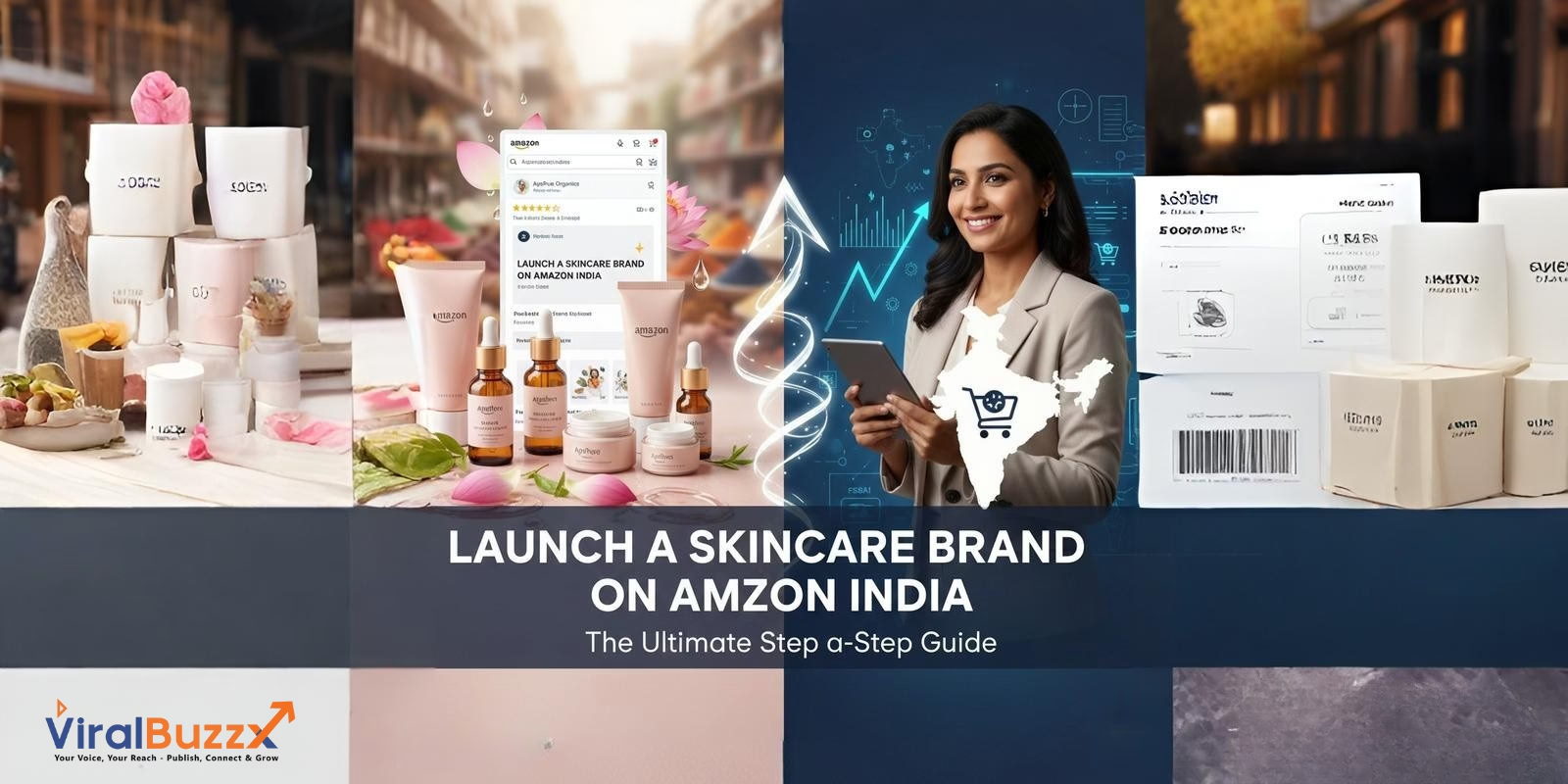
Launch a Skincare Brand on Amazon India: The Ultimate Step-by-Step Guide
📋 Table of Contents
Introduction
India's e-commerce beauty market is projected to reach ₹32,000 crores by 2025, with skincare dominating as the fastest-growing segment. Amazon India has emerged as the primary launchpad for independent beauty entrepreneurs, offering unparalleled reach to 500+ million potential customers. However, launching a skincare brand on Amazon India demands meticulous navigation of India's complex regulatory landscape—specifically FSSAI licensing protocols for cosmetics and GST compliance requirements that can make or break your launch timeline.
This comprehensive guide deconstructs the exact process to launch a skincare brand on Amazon India, from securing mandatory cosmetics licenses to optimizing your first product listing for maximum conversion. Whether you're bootstrapping a private label venture or scaling a manufacturing operation, this roadmap eliminates costly compliance errors while positioning your brand for sustainable profitability.
Phase 1: Legal and Regulatory Compliance
Regulatory compliance forms the non-negotiable foundation for any skincare venture on Amazon India. The platform conducts rigorous document verification, and incomplete licenses result in immediate account suspension.
FSSAI License Requirements for Cosmetics
While FSSAI (Food Safety and Standards Authority of India) primarily regulates food products, skincare items containing ingestible ingredients or making health claims require FSSAI registration. However, most cosmetics fall under the Drugs and Cosmetics Act, 1940, administered by the Central Drugs Standard Control Organization (CDSCO).
Cosmetics Manufacturing License (Form COS-5):
- Application Fee: ₹2,500 registration + ₹1,000 inspection fee
- Technical Staff Requirement: At least one qualified person with a degree in Pharmacy, Chemistry, or Biochemistry
- Manufacturing Premises: Inspection-ready facility meeting Schedule M-II hygiene standards
- Processing Time: 60-90 days post-inspection
- Validity: Renewable annually
Cosmetics Import License: If you're sourcing finished products internationally, you must obtain registration from the Drug Controller General of India (DCGI). This requires certificate of analysis from the country of origin, product formulation details, free sale certificate, and application fee of ₹5,000-₹10,000 depending on product category.
Critical Compliance Point: Amazon India mandates uploading your cosmetics license in Seller Central before listing any skincare products. Private label sellers often underestimate the 3-4 month lead time for license approval—begin this process before ordering inventory.
GST Registration for Amazon Sellers
GST (Goods and Services Tax) registration is mandatory for all Amazon sellers in India, regardless of turnover threshold. The standard 18% GST applies to most cosmetics, with specific exemptions for ayurvedic formulations under HSN code 3304.
GST Registration Process:
- Visit the GST Portal: Access www.gst.gov.in and select "New Registration"
- Temporary Registration Number (TRN): Obtain TRN using business PAN, mobile number, and email (valid for 15 days)
- Document Submission: PAN card of business/proprietor, Aadhaar card for verification, business address proof, bank account statement with cancelled cheque, and digital signature (for companies/LLPs)
- Application Review: 7-10 working days for GSTIN issuance
- Link to Amazon Seller Central: Upload GSTIN certificate in the "Tax Information" section
GST Compliance for Amazon FBA India: When using Fulfillment by Amazon (FBA), Amazon acts as a deemed supplier and collects Tax Collected at Source (TCS) at 1% on transactions exceeding ₹5 lakhs per quarter. You must file monthly GSTR-1 (outward supplies) and GSTR-3B (summary return) to claim input tax credit on FBA fees.
Trademarking Your Brand in India
A registered trademark protects your brand identity and is essential for enrolling in Amazon Brand Registry, which unlocks A+ Content and Sponsored Brands advertising.
Trademark Registration Steps:
- Trademark Search: Conduct comprehensive search on ipindia.gov.in to ensure availability (Class 3 for cosmetics)
- Application Filing: File Form TM-A with ₹4,500 fee (online) or ₹5,000 (physical filing)
- Examination: 12-18 months for examination report
- Journal Publication: 4 months for opposition period
- Registration Certificate: Issued upon successful opposition period completion
Timeline: 18-24 months for complete registration. File your trademark application during the license procurement phase to run processes in parallel.
Phase 2: Sourcing and Inventory Strategy
Your sourcing model directly impacts margins, quality control, and scalability. India's skincare manufacturing landscape offers diverse options for entrepreneurs at every budget level.
Private Label vs. Contract Manufacturing
Private Label Cosmetics India: Private labeling allows you to rebrand existing formulations from established manufacturers, drastically reducing development costs and time-to-market.
Advantages:
- Low MOQ: Start with 500-1,000 units for most products
- Faster Launch: 45-60 days from order to delivery
- Cost Efficiency: ₹80-₹150 per unit for face serums/creams (100ml)
- Compliance Included: Reputable manufacturers provide all required licenses and test reports
Top Private Label Hubs:
- Gujarat (Ahmedabad/Vapi): Specializes in herbal/ayurvedic formulations
- Maharashtra (Mumbai/Aurangabad): Premium Korean beauty-inspired products
- Tamil Nadu (Chennai): Competitive pricing for basic skincare ranges
Amazon FBA India: Fulfillment Strategy
Amazon FBA India handles storage, packing, shipping, and customer service, allowing you to focus on marketing and product development. However, understanding the fee structure is critical for profitability.
Amazon FBA India Fee Structure (2025):
- Fulfillment Fees: Small, light items (≤500g): ₹32-₹40 per unit; Standard size (501g-1kg): ₹48-₹60 per unit
- Weight Handling: Local shipping: ₹15-₹30 per kg; Regional: ₹30-₹50 per kg; National: ₹50-₹80 per kg
- Storage Fees: ₹25-₹40 per cubic foot/month (standard size)
- Referral Fees: Beauty & Personal Care: 12-15% of selling price
- 2025 Update: Zero referral fees for products priced under ₹300
FBA Optimization Strategy: Send 1,000-1,500 units initially for 30-45 day inventory coverage, maintain 15-day stock buffer to avoid stockouts, utilize distributed network for faster delivery, and maintain Inventory Performance Index (IPI) >500 to avoid storage limits.
Phase 3: The Killer Amazon Listing
Your product listing is your digital storefront. A poorly optimized listing hemorrhages potential sales, even with superior products.
Keyword Research: Hindi and English Mix
Amazon India's customer base searches in both English and Hinglish (Hindi words in Roman script), requiring bilingual keyword integration.
Primary Keyword Examples for Skincare:
- English: "vitamin C serum," "retinol cream," "hyaluronic acid moisturizer"
- Hinglish: "face serum for glowing skin," "dark circles cream," "pimple hatane ki cream"
Keyword Placement Strategy: Include primary keyword + key benefit + size in product title (150-200 characters). Integrate 3-5 secondary keywords naturally across 5 bullet points. Utilize all 250 bytes in backend search terms with Hindi/English variations, misspellings, and synonyms.
Product Photography Standards for India
Amazon India has specific image requirements that directly impact conversion rates and search ranking.
Mandatory Image Requirements:
- Main Image: Pure white background (RGB 255, 255, 255), product occupies 85% of frame, minimum 1000x1000 pixels
- Lifestyle Images: Show product in use, on various skin tones (critical for Indian market representation)
- Infographic Images: Highlight ingredients, benefits, usage instructions with text overlays
- Before/After: If making efficacy claims, include disclaimer and actual user results
A+ Content: Brand Story Module
Amazon Brand Registry members access A+ Content (formerly Enhanced Brand Content), which increases conversion by 3-10% on average.
Essential A+ Content Modules: Brand Story Header (300-500 word narrative), Ingredient Spotlight (detailed breakdown of hero ingredients), Comparison Chart (position against 3 competitors), Usage Guide (step-by-step application with visuals), and Customer Testimonials (integrate 5-star review snippets).
Phase 4: Launch and Marketing Strategy
A structured launch strategy determines whether your product gains momentum or languishes on page 10 of search results.
The 30-Day Amazon Launch Plan
Days 1-7: Soft Launch (Friends & Family) - Offer 50-70% discount codes to 20-30 known buyers to generate first 15-20 verified reviews at final retail price.
Days 8-15: Early Reviewer Program - Enroll in Amazon's Early Reviewer Program (₹5,000 one-time fee) to accelerate review generation. Target 5-10 additional organic reviews.
Days 16-30: Aggressive PPC Launch - Launch Amazon Sponsored Products campaigns targeting high-intent keywords. For businesses seeking to master advanced digital marketing tactics, integrating multi-channel strategies amplifies your launch velocity.
PPC Campaign Structure:
- Automatic Campaigns: Daily budget ₹500-₹1,000, Target ACOS 50-80% during launch, run for 14 days to discover keywords
- Manual Exact Match: Extract top 20 converting keywords, increase bids by 300% for top-of-search, daily budget ₹1,500-₹3,000, Target ACOS 40-60%
- Product Targeting: Target competitor ASINs priced 10-20% higher, daily budget ₹500-₹800
ACOS Optimization Timeline: Weeks 1-4 tolerate 60-80% ACOS to gain ranking, Weeks 5-8 optimize to 35-50% ACOS, Month 3+ maintain profitable 20-35% ACOS.
Initial Rating Strategy
Amazon's algorithm heavily weights products with 15+ reviews and 4.0+ star ratings.
Review Generation Tactics: Amazon Vine Program (invite Amazon's trusted reviewers), Email Follow-ups (use "Request a Review" button), Product Inserts (include QR code linking to listing), and Address Negative Reviews (respond within 24 hours offering solutions).
Review Velocity Target: Aim for 2-3 new reviews weekly during first 60 days to signal strong product-market fit to Amazon's algorithm.
Estimated Startup Costs Breakdown
Below is a comprehensive cost breakdown for launching a skincare brand on Amazon India with 2 SKUs (1,000 units each).
| Cost Category | Description | Estimated Cost (INR) |
|---|---|---|
| Legal & Compliance | ||
| Cosmetics Manufacturing License | State authority fee + inspection | ₹3,500 |
| GST Registration | Online application | ₹0 - ₹2,000 |
| Trademark Registration | Class 3 filing (DIY) | ₹4,500 |
| Business Registration | Proprietorship/OPC/LLP | ₹5,000 - ₹15,000 |
| Product Development | ||
| Private Label Inventory (2 SKUs) | 1,000 units × 2 × ₹120/unit | ₹2,40,000 |
| Product Testing | Stability + safety testing | ₹20,000 |
| Packaging Design | Professional design for 2 SKUs | ₹15,000 |
| Amazon Setup | ||
| Seller Account | Professional plan (annual) | ₹20,000 |
| Brand Registry | Free (with trademark application) | ₹0 |
| Product Photography | Professional shoot (2 SKUs) | ₹40,000 |
| Logistics | ||
| Initial FBA Shipment | Shipping 2,000 units to Amazon FC | ₹8,000 |
| FBA Storage (First 2 months) | ~100 cubic feet × ₹30/cu.ft | ₹6,000 |
| Marketing (First 60 Days) | ||
| Amazon PPC Campaigns | ₹2,000/day × 60 days | ₹1,20,000 |
| Early Reviewer Program | 2 ASINs × ₹5,000 | ₹10,000 |
| Influencer Seeding | 10 micro-influencers | ₹25,000 |
| Operating Buffer | ||
| Miscellaneous & Contingency | 10% of total | ₹50,000 |
| TOTAL ESTIMATED INVESTMENT | ₹5,69,000 - ₹5,79,000 | |
Profitability Timeline: Most private label skincare brands achieve breakeven by month 4-6 with disciplined PPC management and inventory turnover optimization.
Conclusion
Launching a skincare brand on Amazon India represents a high-potential entrepreneurial pathway, but success demands respect for India's regulatory complexity and Amazon's algorithmic preferences. The trifecta of flawless compliance (FSSAI/CDSCO + GST), strategic FBA utilization, and data-driven PPC execution separates thriving brands from dissolved ventures.
Key Risk Factors:
- Regulatory Audits: CDSCO conducts random cosmetics audits; maintain updated licenses and product test reports
- Amazon Account Health: Late shipments, policy violations, or counterfeit complaints trigger suspension
- Cash Flow Management: FBA fees (15-25% of selling price) require robust pricing strategy
Next Steps:
- Initiate cosmetics license application this week (longest lead time item)
- Shortlist 3-5 private label manufacturers and request samples
- Secure GST registration within 15 days
- Reserve ₹1.5-₹2 lakhs for initial inventory + marketing
For entrepreneurs seeking to amplify their e-commerce expertise or establish thought leadership, contributing insights to a free guest posting site positions you as an industry authority while building backlinks to your brand domain.
The Indian skincare market is fragmented, with no dominant private label leader—creating unprecedented opportunity for agile entrepreneurs who execute with precision. Your 90-day launch clock starts now.
Ready to Launch Your Skincare Brand?
Download our complete Amazon India seller checklist and regulatory compliance templates.
Get the Free Resources Read More E-commerce Guides